




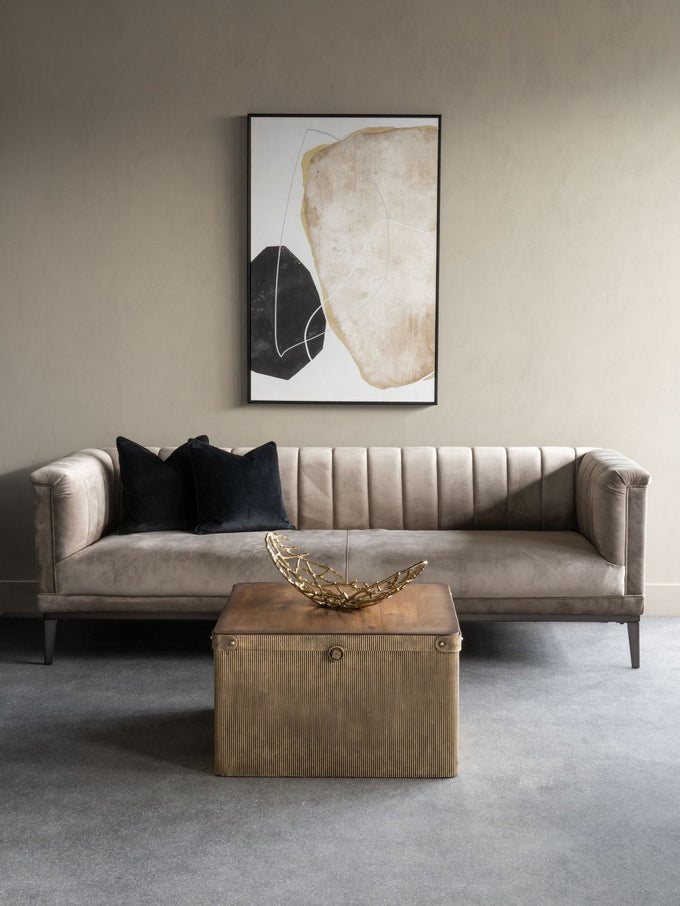
A sofa is the piece of furniture you will touch every single day, and usually the one you keep longest. It is also the easiest to get wrong: a few centimetres of depth, the wrong cushion fill or a doorway nobody measured can turn the centrepiece of a living room into a daily irritation. This guide covers what we ask customers in our showroom before they choose, in the same order we ask it.
Start with the room, not the sofa
Before looking at a single design, mark the footprint out on the floor with masking tape. As a rule of thumb, allow at least 45–50cm of walkway around the sofa, and keep roughly 40–45cm between the seat and a coffee table — close enough to reach a cup, far enough to walk through. A sofa that looks modest in a large showroom almost always reads bigger at home.
Think about orientation too. If the sofa will sit with its back to the room's entrance, a design that is finished on all sides matters far more than one destined for a wall. Corner and chaise designs anchor open-plan spaces well, but in smaller rooms two smaller pieces — a two-seater with an accent chair — often work harder than one large one, and give you two focal points instead of a single wall of upholstery.
Two-seater or three-seater?
The names are less useful than the measurements. A generous two-seater can offer more usable seat than a tight three-seater, so always compare internal seat width, not the label. Broadly:
- 2-seater sofas typically run 150–180cm wide — right for snugs, offices, bay windows and as the second sofa in an L-shaped arrangement.
- 3-seater sofas typically run 200–240cm — the standard family sofa, and the minimum if anyone intends to lie down on it.
Check seat depth against how you actually sit. A shallower seat (roughly 55–60cm) supports an upright, conversational posture; a deep seat (65cm and beyond) is made for lounging but can leave shorter sitters with their feet off the floor. If the household disagrees, deep seat plus a firm back cushion is the usual compromise.
The frame is the sofa
Everything you can see can be replaced or cleaned; the frame cannot. Hardwood and engineered-timber frames that are glued, dowelled and screwed — not just stapled — are what separate a ten-year sofa from a three-year one. Weight is a surprisingly honest signal: quality frames are heavy. If you can easily lift one end of a full-size sofa alone, ask questions.
Cushion fills, honestly compared
- Foam holds its shape with no daily plumping and gives a tailored, architectural look. Higher-density foam softens slightly over the first months, then plateaus.
- Fibre is softer and more relaxed but needs regular plumping to avoid flattening.
- Feather & down gives that sink-in, hotel-suite comfort, at the price of daily plumping and a gentle informality — it never looks crisp.
- Feather-wrapped foam is the popular middle path: a foam core for structure with a feather jacket for softness.
Choosing the fabric
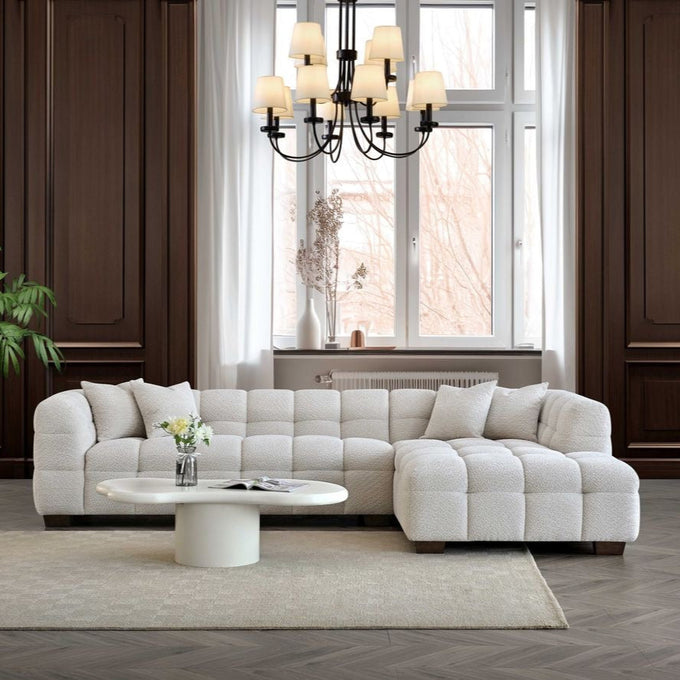
Fabric decides how the sofa ages as much as how it looks. Tight weaves and flat weaves take daily family use best; textured bouclé brings warmth and depth to plain silhouettes; velvet rewards rooms with good light and owners happy to brush the pile now and again. For busy households, ask about rub counts — for everyday domestic use you want a Martindale figure of roughly 20,000 or higher — and check whether covers are removable. We cover the full fabric decision, including pets-and-children realism, in our upholstery fabric guide.
On colour: the safest expensive-looking choices remain warm neutrals — oatmeal, taupe, soft grey — dressed with cushions and throws from the season's palette. A boldly coloured sofa is a commitment to build a room around; a neutral one is a stage you can redecorate against for a decade.
The measurement everyone forgets
More sofa deliveries fail on access than on anything else. Before ordering, measure:
- the front door — width and height;
- any hallway pinch points, radiators and bannisters on the route;
- internal door widths;
- for flats: the lift's internal depth, or the stairwell's turning space.
Compare these against the sofa's packaged dimensions, not just its listed size, and remember that many designs arrive with feet unattached, buying you a few extra centimetres. If access is tight, look for designs with removable arms or backs — and if in doubt, ask us before you order rather than on delivery day.
Delivery, returns and living with it
We offer free UK delivery on orders over £100, and our team can advise on lead times for made-to-order upholstery before you commit. Once it arrives: rotate and flip loose cushions weekly in the first months while fills settle, keep sofas out of strong direct sunlight (every fabric fades), and vacuum upholstery gently with a soft brush attachment — grit, not use, is what wears fabric fastest.
Ready to look? Start with our full sofa collection, or narrow it down by two-seaters and three-seaters — and if you would like a second opinion on sizes or fabrics, our showroom team is always happy to talk a plan through.